


Introduction
Water sits at the core of almost every industrial process, and its quality directly affects product quality, equipment life, and operating costs. For industries that cannot compromise on purity, reverse osmosis (RO) membranes are the technology of choice.
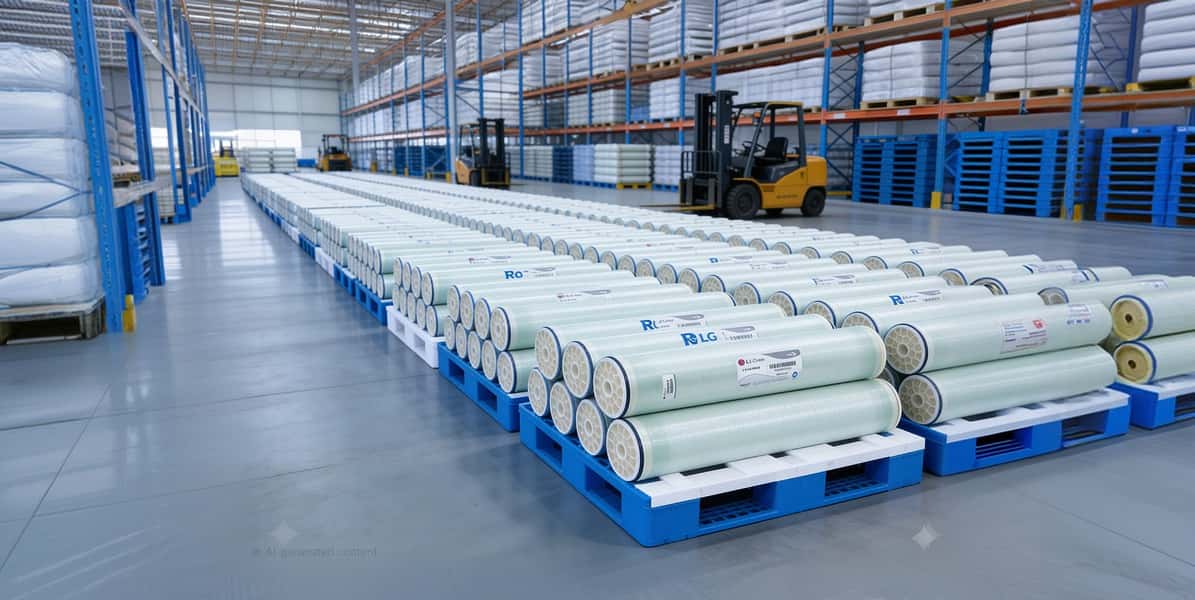
RO membranes are the central separation element in modern water treatment systems. They remove dissolved salts, heavy metals, bacteria, viruses, and chemical contaminants with a high degree of reliability across pharmaceuticals, food processing, seawater desalination, and municipal supply.
Selecting the right membrane, maintaining it correctly, and understanding what affects performance are not always straightforward. This guide covers what an RO membrane is, how it works, system components, membrane types and materials, fouling, cleaning, lifespan, and selection criteria — whether you are specifying a new system, troubleshooting, or planning replacement.
Why the right membrane — and timely care — matter
A high-quality membrane underperforms when operating conditions fall outside the design envelope. Fouling, poor pretreatment, and delayed replacement raise energy use, cut permeate quality, and shorten service life.
Effective membrane selection and maintenance protect:
- High salt rejection and stable permeate quality
- Lower long-term chemical, energy, and downtime costs
- Membrane longevity through pretreatment and CIP discipline
- Correct BW vs SW matching to feed salinity
- Protection of TFC membranes from chlorine damage
- Planned replacement instead of unplanned production losses

For industries in the UAE and GCC — where hard, high-TDS groundwater and desalinated water are common — membrane choice and maintenance are core operational decisions, not afterthoughts.
How long do industrial RO membranes last?
Most industrial RO membranes last between 3 and 5 years under normal operating conditions. Systems with effective pretreatment and consistent maintenance often achieve longer service lives; poor feed water or inadequate maintenance typically shorten that window.
There is no universal calendar interval for replacement. Normalized permeate flow and salt rejection trends are the most reliable indicators. Age alone is a weaker trigger than performance monitoring tied to commissioning baselines.
Warning signs your RO membrane may need replacement
Declining permeate flow rate
A sustained drop in output at the same operating pressure indicates fouling or membrane degradation that cleaning cannot fully reverse.
Rising operating pressure
If the system needs progressively more pressure to maintain permeate output, membrane resistance is increasing and performance is under stress.
Deteriorating permeate water quality
Rising TDS, conductivity, or specific contaminant levels in the permeate stream indicate a loss of salt rejection.
Increasing energy consumption
Higher pump energy use to compensate for reduced membrane performance is a practical early warning that the membrane is working harder for less output.
Shortening cleaning intervals
If cleaning is required more frequently than the baseline set during commissioning, the membrane is likely approaching end of life.
Fouling that cleaning cannot fully reverse
Scaling, biofouling, organic fouling, and colloidal fouling all reduce performance. When normalized trends show irreversible decline after CIP, planned replacement avoids unplanned downtime.
RO membrane cleaning and what it can — and cannot — restore
Routine maintenance preserves performance and maximizes operational life. Chemical cleaning (CIP) can restore performance when fouling is the primary cause of decline — but not when damage is irreversible.

Cleaning can address
- Organic fouling and biofouling with alkaline (high pH) cleaners
- Scaling and mineral deposits with acid (low pH) cleaners
- Recoverable colloidal and organic buildup when caught early
- Performance dips reversed by proactive CIP based on normalized trends

Cleaning cannot fix
- Physical membrane damage
- Irreversible chemical degradation such as chlorine oxidation of a TFC polyamide layer
- End-of-life rejection loss that no longer responds to CIP
- Damage caused by failed pretreatment components left unaddressed
Schedule CIP from normalized performance trends, not only after severe deterioration. Match cleaners to fouling type, keep antiscalant dosing correct, and fully dechlorinate feed water before TFC membranes.
How to extend RO membrane life
With the right practices, most industrial RO membranes perform reliably for 3 to 5 years — and longer in well-managed systems with high-quality feed:
- Invest in effective pretreatment— sediment, chlorine removal, and related steps have a greater impact on membrane life than almost any other factor
- Monitor normalized performancefor permeate flow, operating pressure, differential pressure, and permeate quality against commissioning baselines
- Follow a proactive CIP schedulebased on operating hours or performance triggers rather than waiting for severe decline
- Manage recovery rates carefullywithin the range suited to your feed water chemistry to limit scaling
- Use manufacturer-compatible chemicalsfor antiscalants and cleaners, and stay within pressure, temperature, and pH guidelines
- Dechlorinate before TFC membranesusing activated carbon filtration or sodium metabisulfite dosing

Pair these practices with the right BW or SW membrane, size (4040 or 8040), and material choice after a full feed water analysis.
Frequently Asked Questions
Most industrial RO membranes last between 3 and 5 years under normal operating conditions. Effective pretreatment and consistent maintenance often extend service life; poor feed water or inadequate maintenance shorten it.
Yes. CIP can restore performance when fouling is the main cause of decline. If the membrane has physical damage or irreversible chemical degradation — such as chlorine oxidation of a TFC membrane — cleaning will not restore performance and replacement is necessary.
The four main types are scaling (mineral deposits), biofouling (bacterial biofilm), organic fouling (natural organic matter), and colloidal fouling (fine particle deposition). Each needs a different prevention strategy and cleaning approach.
Brackish water (BW) membranes suit low-to-moderate salinity feed and operate at lower pressures (typically 5–20 bar). Seawater (SW) membranes suit high-salinity sources such as ocean water, need higher pressure (typically 55–70 bar), and deliver very high salt rejection.
For most industrial applications, yes. TFC membranes offer higher salt rejection, better permeate flow, and longer service life, but feed water must be dechlorinated. Cellulose acetate membranes tolerate limited chlorine but are generally considered legacy technology in modern designs.
Conclusion
RO membranes are the most critical performance component in industrial water treatment. Their ability to remove dissolved salts, contaminants, and microorganisms makes them essential from food and pharmaceuticals to desalination and manufacturing.
Getting the most from membranes means combining the right product with effective pretreatment, proper system design, ongoing performance monitoring, and consistent maintenance — for reliable output, longer membrane life, and lower total operating costs.
Share this story


