


Introduction
Industries that use water every day cannot afford to let quality standards slip. Hotels in Dubai, manufacturing plants, and pharmaceutical facilities all depend on consistent water quality for performance, safety, and controlled operating costs.
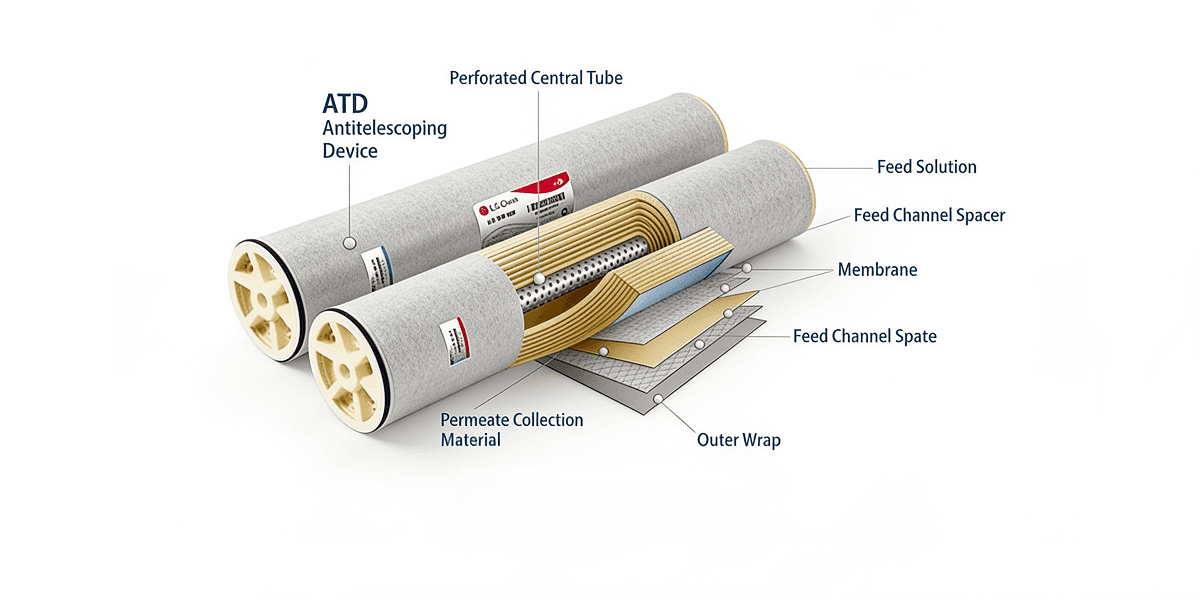
Reverse osmosis has become a common purification method because each system depends on a core component: the RO membrane. Understanding how that membrane works is essential when selecting reliable membranes from suppliers in the UAE.
Unlike traditional filters that mainly trap particles, a semi-permeable RO membrane removes dissolved minerals, pollutants, and microorganisms at a molecular scale. Businesses across the region rely on industrial RO membrane solutions for uniform, high-quality water production.
Why membrane knowledge matters when you select and maintain RO systems
The membrane is the heart of reverse osmosis. Poor selection, weak pretreatment, or unmanaged operating conditions cut performance and raise costs. Knowing what the membrane removes — and what protects it — keeps industrial water quality steady.
Getting membrane selection and protection right supports:
- Removal of dissolved salts and TDS
- Control of heavy metals and organic chemicals
- Reduction of bacteria and harmful microorganisms
- Longer membrane service life through proper pretreatment
- More efficient treatment systems and lower operating costs
- Reliable water quality for hotels, industry, and desalination

Partnering with professional water treatment equipment suppliers in the UAE helps maximize system efficiency and long-term membrane performance.
How long do RO membranes typically last?
Industrial RO membranes typically operate effectively for 3 to 5 years, depending on feed water quality and maintenance practices.
Durability depends heavily on pretreatment. Chlorine, sediments, and scaling agents should be addressed before pressurized water reaches the membrane — especially for Thin Film Composite (TFC) membranes, which are sensitive to chlorine exposure.
Key factors that shape RO membrane performance
Feed water quality
Raw water composition drives how hard the membrane must work. Dissolved salts, heavy metals, organics, nitrates, sulfates, silica, and fine suspended particles all influence rejection demand and fouling risk.
Operating pressure
Reverse osmosis moves pressurized water through semi-permeable layers. A high-pressure pump must raise water to the required operating level so clean water molecules pass while contaminants remain behind.
Water temperature
Temperature is one of the controlled variables that affect throughput and overall membrane performance. It should be managed alongside pressure and recovery for stable results.
Recovery efficiency
Recovery percentage must be balanced carefully. An experienced industrial RO membrane supplier designs the system from the start to maximize performance and reduce operating costs.
Pretreatment effectiveness
Pretreatment removes chlorine, sediments, and scaling agents before the membrane stage. System protection is essential for maintaining high-quality RO membranes in Dubai because durability depends heavily on this step.
Membrane type and chlorine exposure
Modern systems commonly use Thin Film Composite (TFC) membranes for industrial working environments, throughput, and service life. Because TFC membranes are sensitive to chlorine, proper pretreatment and protection are essential.
What pretreatment and system design protect — and what they cannot replace
Pretreatment and correct system design protect the membrane, but they do not replace the need for the right membrane size, material, and supplier for your application.

Proper pretreatment and design help address
- Chlorine before it reaches chlorine-sensitive TFC membranes
- Sediments that would otherwise load the membrane surface
- Scaling agents that threaten long-term performance
- Inefficient operating setpoints through professional system design

Pretreatment alone cannot replace
- Choosing the wrong membrane size (for example, 4040 vs 8040 capacity needs)
- Skipping membrane selection based on application requirements
- Ignoring feed water quality, pressure, temperature, and recovery limits
- Expecting a traditional particle filter to deliver molecular-level RO rejection
Aqua Flair Trading LLC supplies water treatment equipment in the UAE and supports membrane selection, installation, maintenance, and performance optimization.
Getting more life and value from your RO membrane
Membrane longevity and system efficiency improve when selection, pretreatment, and operating discipline work together:
- Specify the right membrane for the job— 4040 membranes suit smaller commercial systems, while 8040 membranes serve larger industrial capacity needs
- Protect TFC membranes from chlorinewith pretreatment that removes chlorine before contact
- Control feed quality, pressure, temperature, and recoveryso the membrane operates within an efficient envelope
- Use pretreatment for sediments and scaling agentsbefore pressurized water reaches the membrane
- Work with a supplier that supports selection and upkeepincluding guidance, installation, maintenance, and troubleshooting

In the UAE, RO membranes support desalination, industrial water reuse, commercial supply, and reduced pressure on traditional water sources — when systems are specified and protected correctly.
Frequently Asked Questions
RO membranes filter molecular-level contaminants, while standard filters mainly block larger particles and sediments.
Yes. Reverse osmosis membrane technology can remove bacteria and many viruses. Proper pretreatment and disinfection remain essential.
Permeate is the purified water that passes through the reverse osmosis membrane after treatment.
Concentrate is the reject stream containing impurities removed during the reverse osmosis process.
4040 membranes are commonly used in smaller commercial systems, while 8040 membranes are designed for larger industrial applications that need higher capacity.
Conclusion
Every reverse osmosis system relies on its core RO membrane. Industries that need reliable water quality depend on membranes that remove dissolved salts, contaminants, and microorganisms with high efficiency.
Success also depends on choosing the right RO membrane supplier in the UAE. A trusted partner provides quality products and helps sustain long-term performance, operational reliability, and cost-effective treatment.
Share this story


